For hospital CFOs, revenue cycle leaders, and patient financial services teams
Ten years ago, a hospital’s biggest collection problem was usually a payer: a denial to appeal, a slow remittance to chase. Today it’s more often the patient. High-deductible health plans (HDHPs) have quietly moved a large part of the hospital revenue stream away from well-capitalized payers and onto household balance sheets. For hospitals running on thin operating margins, that shift has become a liquidity problem, not just a collections problem.
The Shift in Risk: From Payer Credit to Consumer Credit
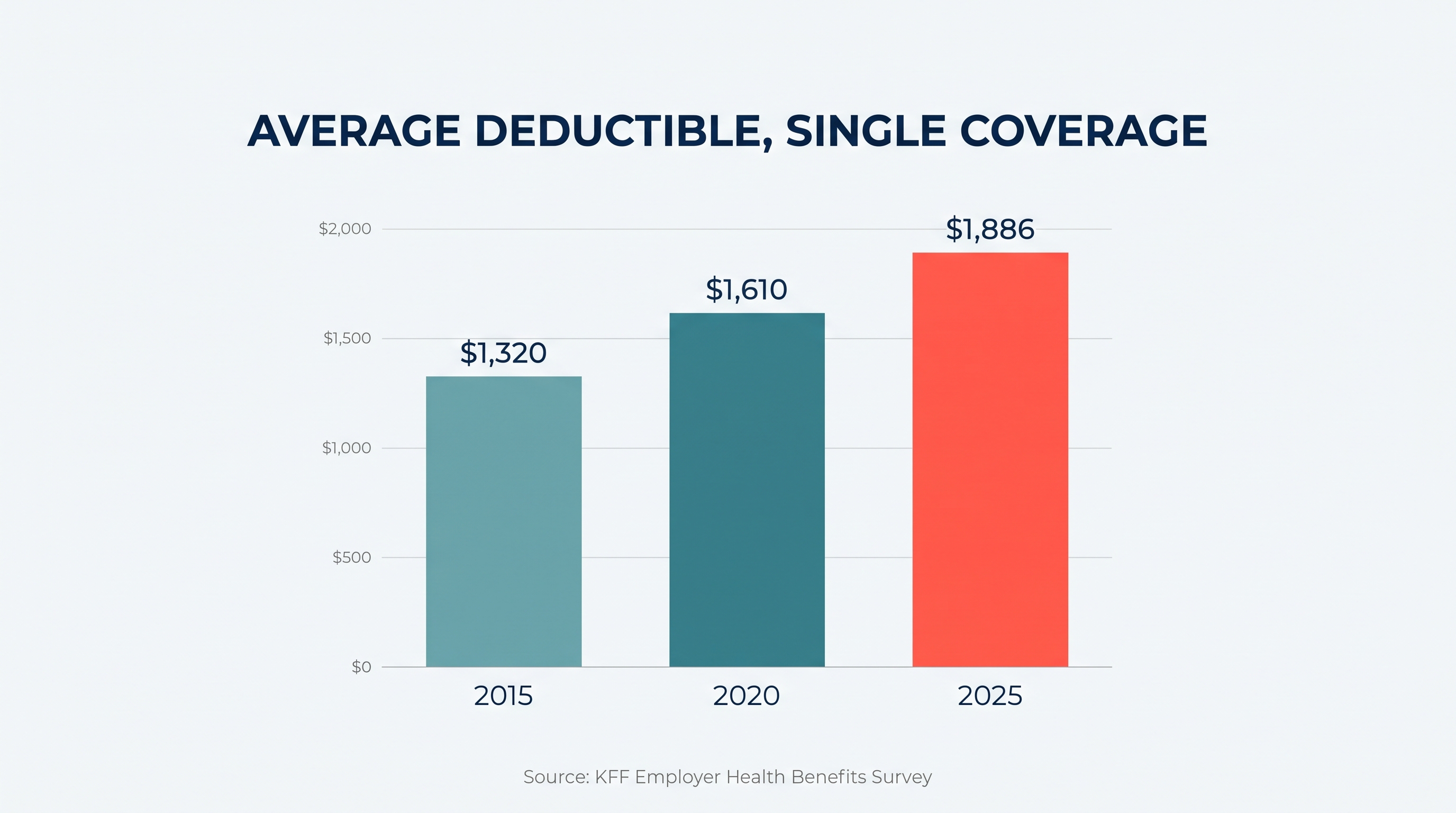
HDHPs are now a core part of employer-sponsored coverage. Per KFF’s 2025 Employer Health Benefits Survey, 33% of covered workers are enrolled in a high-deductible plan with a savings option, and deductibles keep climbing across all plan types. The average single-coverage deductible was $1,886 in 2025, up 17% over five years and 43% over the past decade. About 34% of covered employees now face a single-coverage deductible of $2,000 or more, a share that has grown 77% in ten years. (2025 Employer Health Benefits Survey | KFF)
The economic effect is simple. Every dollar of deductible, co-pay, and coinsurance is a dollar that no longer comes from Medicare, Medicaid, or a commercial insurer. It now has to come from an individual patient.
That is a real change in credit quality. Traditional Medicare and Medicaid claims are backed by the federal and state governments, which is effectively sovereign credit. Major commercial insurers are large, regulated, well-capitalized counterparties. Patients are not. Many don’t have $2,000 set aside for an unexpected hospital stay, and a surprise bill competes with rent, groceries, and car payments. The result is predictable: self-pay balances collect more slowly, collect less, and turn into bad debt at far higher rates than insured balances.
In practical terms, HDHPs have turned part of a hospital’s receivables from investment-grade paper into consumer credit, and hospitals are carrying that risk without the pricing, underwriting, or reserves a consumer lender would use.
Operational Stagnation: How Patient Balances Drag Down the Whole Cycle
The damage doesn’t stay inside the self-pay bucket. Patient responsibility slows the entire revenue cycle:
- Sequencing delays. The patient’s share usually can’t be finalized until the payer adjudicates the claim. The hospital waits for the payer, then bills the patient, then waits again.
- Longer tails. Patient statements go through multiple billing cycles, payment plans, and eventually collections referrals. Balances that stay open for months keep Days in Accounts Receivable (DAR) high even when payer performance is solid.
- Higher cost to collect. Patient financial services teams spend disproportionate time and money on small-dollar, high-volume balances, including statements, calls, portals, financial assistance screening, and payment plan management.
- Forecasting uncertainty. Self-pay recovery rates are volatile, which makes cash planning harder and pushes finance teams to hold larger reserves or lean on revolving credit lines.
The outcome is a cash conversion cycle that gets longer and less predictable every year, while payroll, supplies, and vendor obligations don’t wait.
The Liquidity Shield: Monetizing Clean Insured Claims
Hospitals can only do so much to make patients pay faster, and they shouldn’t try to squeeze households harder. What they can control is the timing of the cash they’re already owed by reliable payers.
That is where same-day claims monetization comes in. Clean Medicare, Medicaid, and commercial claims are among the highest-quality assets on a hospital’s balance sheet: strong counterparties, predictable adjudication, and well-understood payment patterns. Waiting 30, 45, or 60+ days to collect them doesn’t have to dictate your cash position.
Capital Pulse converts those insured receivables into immediate working capital:
- Same-day liquidity. Clean claims can be funded the same day they’re submitted, so cash arrives closer to the time care is delivered.
- Data-driven underwriting. Our proprietary Healthcare Claims Scoring System (HCSS) evaluates claims individually, so funding reflects the actual quality of each receivable.
- True sale, non-recourse. Claims are purchased outright, so hospitals gain off-balance-sheet liquidity without adding debt and, in many cases, without restrictive covenants.
- Retained servicing. Hospitals keep their payer relationships and existing revenue cycle workflows. Nothing changes from the payer’s perspective.
- Transparent pricing. SOFR-based pricing ties the cost of capital to a clear market benchmark.
The strategic logic is a division of labor. Insured claims, which are the reliable part of the revenue stream, become immediate cash that funds daily operations. That frees patient financial services teams to handle patient balances the right way: with patience, financial counseling, reasonable payment plans, and charity care screening, instead of under pressure to close a cash gap.
The Bottom Line
HDHPs aren’t going away. Deductibles will likely keep rising, and patient responsibility will keep growing as a share of hospital revenue. Hospitals that treat this only as a collections challenge will keep fighting a slow, expensive battle against consumer credit risk.
Hospitals that treat it as a liquidity challenge have a better option: unlock the value of their strongest receivables today and let the slower, riskier balances follow their natural course without putting operations at risk.
To see how same-day claims monetization could shorten your cash conversion cycle, contact the Capital Pulse team.
Sources:


